Africa’s trade with Southeast Asia could nearly double to $112 billion by 2035

Africa’s economic ties with Southeast Asia are entering a new phase, with bilateral trade increasingly complemented by industrial partnerships, local manufacturing and cross-border investment. A new report by the Alliance des Patronats Francophones and the Cambodia Chamber of Commerce, produced in cooperation with Eurogroup Consulting, forecasts that trade between the two regions could nearly double to $112 billion by 2035.
Africa is becoming an increasingly important player in the changing geography of global trade. Trade between developing economies – known as South–South trade – now accounts for 26% of global merchandise trade, up from just 11% in 2000. Meanwhile, 53% of African exports are destined for developing economies, compared with 25% in 1995.
One of the emerging opportunities for Africa lies in strengthening its economic relationship with the Association of Southeast Asian Nations (ASEAN), a region that has established itself as a major global manufacturing, technology and investment hub.
According to the report, titled ‘ASEAN-Africa: The Next Corridor’, merchandise trade between the two regions has grown more than eightfold since 2000, reaching $59 billion in 2024. Yet the corridor accounts for just 0.2% of global merchandise trade, with ASEAN absorbing only 4.1% of Africa’s exports.
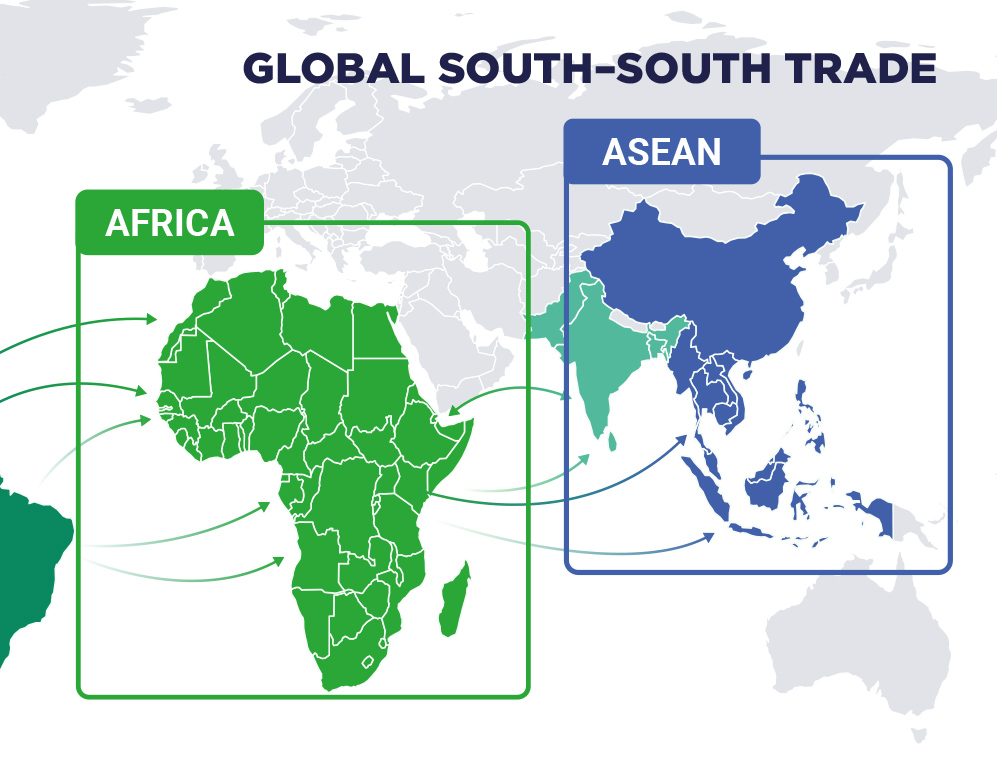
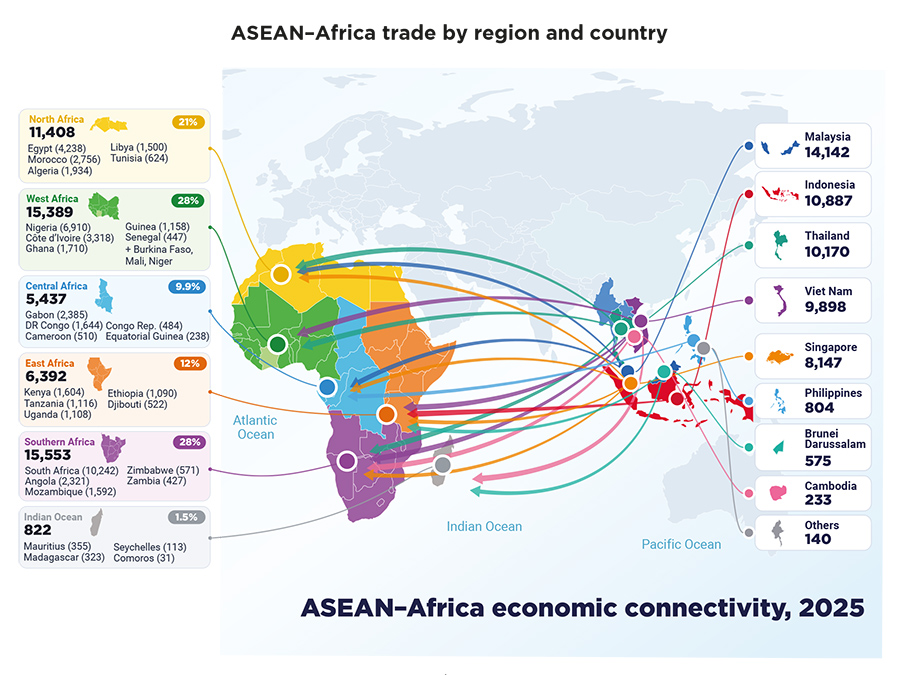
The relationship is also becoming more balanced. Since 2000, African exports to Southeast Asia have increased elevenfold, compared with sevenfold growth in the opposite direction. South Africa, Nigeria, Egypt, Côte d’Ivoire and Morocco are among the continent’s largest trading partners with ASEAN.
Trade could nearly double by 2035
Drawing on economic analysis and interviews with 14 business leaders and experts, the report’s authors outline three scenarios for the development of the corridor.
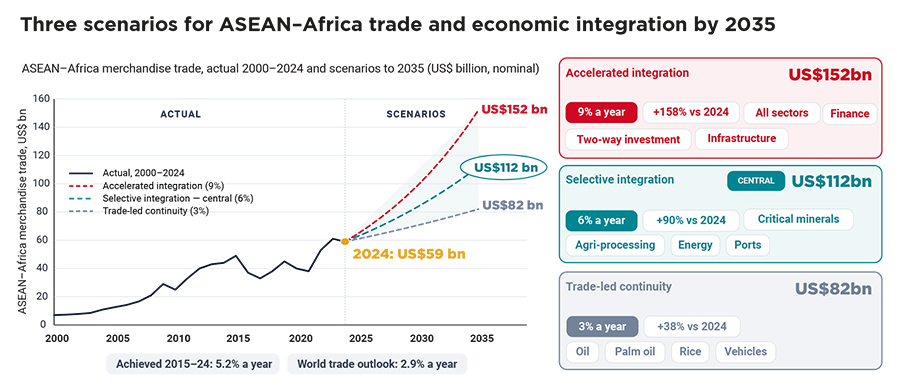
Under the central scenario, annual trade growth of 6% would see merchandise trade reach $112 billion by 2035. A more conservative scenario puts the figure at $82 billion, while accelerated economic integration could push it to $152 billion.
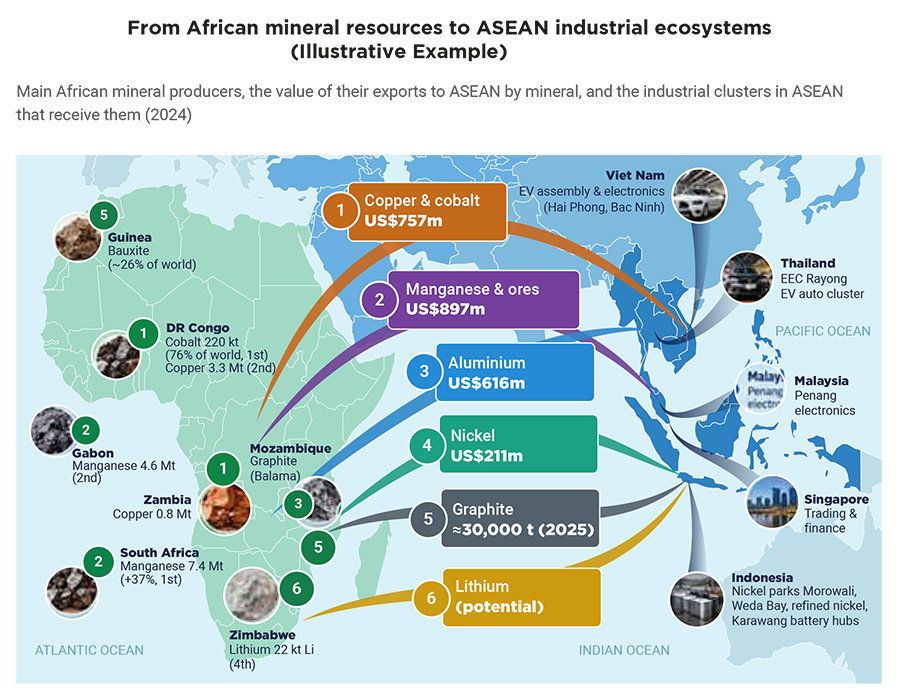
Four trends are expected to drive growth: rising demand for African minerals and industrial inputs, Africa’s expanding consumer markets and industrialisation, global supply chain diversification, and the international expansion of companies, capital and business models.
Seven sectors offering growth opportunities
The researchers identify seven sectors offering significant opportunities for deeper economic cooperation: critical minerals, food and agro-processing, energy, manufacturing, infrastructure and logistics, digital and financial services, and healthcare and pharmaceuticals.
Food and agro-processing ($17.8 billion), energy ($15 billion) and manufacturing ($12.7 billion) currently account for around 77% of merchandise trade between the two regions.
For Africa, a particularly important opportunity lies in moving up the value chain, shifting from exporting raw materials towards local processing, manufacturing and higher-value industrial activities. The African Continental Free Trade Area could further strengthen the business case for establishing regional production hubs.
Several companies are already capitalising on these opportunities. Singapore-based Tolaram operates 13 factories in Nigeria, while Indonesian pharmaceutical group Bio Farma is transferring vaccine technology to Ghana’s Atlantic Lifesciences. Philippine port operator ICTSI operates terminals in five African countries.
The opportunities also run in the opposite direction. South Africa’s Tyme Group launched a digital bank in the Philippines in 2022, attracting more than nine million customers by 2026.
Turning potential into investment
Unlocking the corridor’s full potential will require addressing several barriers to doing business, including information gaps, financing constraints, regulatory differences and inadequate logistics infrastructure.
The authors recommend six areas for action, spanning sector-specific investment opportunities, stronger business partnerships, transaction-based financing, improved physical and digital connectivity, regulatory cooperation and a coordinated Africa-ASEAN business agenda.
“Long considered a secondary trade corridor, ASEAN-Africa is evolving,” said Grégoire Virat, Managing Partner for Middle East & Asia at Eurogroup Consulting. “Companies in both regions are no longer simply exchanging goods: they are expanding their operations into each other’s markets. Lasting partnerships will be those built on commercially viable business models for both sides.”
Ahmed Cissé, President of the Alliance des Patronats Francophones, added: “By bringing Francophone entrepreneurs together in the heart of ASEAN, we want to open new pathways between Africa, Asia and Europe. The economic Francophonie must not simply watch the world change. It must help build the next geography of trade.”